
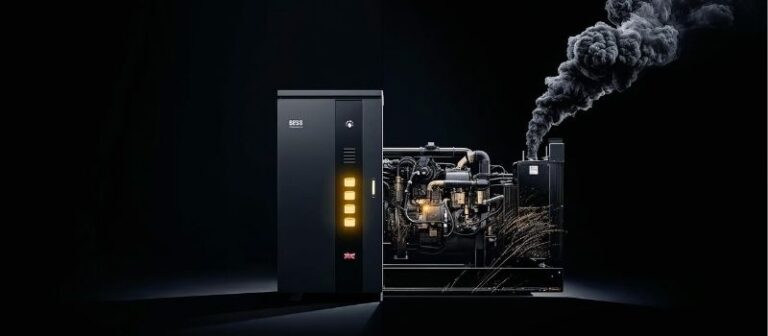
A Modern Approach to Reliable Industrial Energy Resilience
Backup power is a critical requirement for industrial facilities where power interruptions can cause production losses, equipment damage, and safety risks. Traditionally, diesel generators have been the default solution. However, advances in Industrial Energy Storage Systems (Industrial ESS / Industrial BESS) are rapidly changing how factories and infrastructure facilities approach backup power.
This article compares Industrial ESS vs diesel generators for backup power, highlighting technical, operational, and economic differences—particularly relevant for industrial operations in the Middle East.
The Role of Backup Power in Industrial Facilities
Industrial facilities depend on stable power for:
- Continuous manufacturing processes
- Automated production lines
- Control and safety systems
- Data, instrumentation, and monitoring
Even short grid disturbances can result in downtime, scrap losses, or equipment failures. Reliable backup power is therefore essential for operational continuity.
Diesel Generators: Traditional Backup Power Solution
Diesel generators have been widely used due to their ability to provide long-duration backup power. However, they come with several limitations.
Key Characteristics of Diesel Generators
- Mechanical startup delay during power loss
- Fuel storage and logistics requirements
- Regular maintenance and testing
- Noise and vibration
- Emissions and environmental impact
In many industrial applications, diesel generators are oversized to meet peak demand, resulting in inefficient low-load operation.
Industrial ESS as a Backup Power Solution
Industrial ESS provides battery-based backup power, delivering instantaneous energy during grid outages or disturbances. Unlike generators, batteries respond immediately, ensuring seamless power continuity.
Industrial ESS is typically deployed:
- Behind-the-meter
- Integrated with facility electrical systems
- Coordinated through energy and power management systems
Key Differences: Industrial ESS vs Diesel Generators
Response Time
Industrial ESS provides instantaneous backup power, eliminating voltage dips and delays. Diesel generators require startup time, during which sensitive equipment may be exposed to interruptions.
Reliability and Power Quality
Battery systems deliver stable voltage and frequency, protecting sensitive industrial equipment. Diesel generators may experience transient fluctuations during startup and load changes.
Operational and Maintenance Requirements
Industrial ESS has:
- Fewer moving parts
- Lower routine maintenance needs
- Reduced operational complexity
Diesel generators require regular servicing, fuel management, and periodic testing to ensure availability.
Environmental Impact
Diesel generators produce:
- CO₂ emissions
- NOₓ and particulate matter
- Noise pollution
Industrial ESS provides zero-emission backup power, supporting sustainability goals and compliance with environmental regulations—an increasing priority in Middle East industrial zones.
Space and Installation Considerations
Industrial ESS can be:
- Containerized
- Modular
- Installed indoors or outdoors
Diesel generators require:
- Exhaust systems
- Fuel storage areas
- Noise mitigation measures
In space-constrained industrial environments, ESS offers greater flexibility.
Hybrid Backup Power: ESS and Diesel Generators Combined
In many industrial facilities, the most effective solution is a hybrid backup power system.
In this configuration:
- Industrial ESS provides instant backup power
- Diesel generators start and stabilize in the background
- Batteries handle transient loads and short outages
- Generators support extended outages
This approach reduces generator runtime, fuel consumption, and maintenance while maintaining long-duration backup capability.
Middle East Considerations for Industrial Backup Power
Industrial facilities in the Middle East face unique challenges:
- High ambient temperatures
- Increasing electricity tariffs
- Grid capacity constraints
- Strong focus on sustainability and emissions reduction
Industrial ESS solutions designed for hot-climate operation provide reliable backup power while reducing dependence on fuel-based generation.
Economic and Operational Benefits of Industrial ESS Backup Power
While diesel generators have lower upfront costs, Industrial ESS delivers value through:
- Reduced maintenance expenses
- Lower fuel and logistics costs
- Improved uptime and power quality
- Compliance with environmental standards
For facilities with frequent short outages or power quality issues, ESS offers strong lifecycle economics.
Choosing the Right Backup Power Strategy
Selecting between Industrial ESS, diesel generators, or a hybrid system depends on:
- Duration and frequency of outages
- Power quality requirements
- Space and noise constraints
- Environmental and regulatory considerations
- Total cost of ownership
A properly engineered backup power strategy often combines both technologies to maximize resilience and efficiency.
Conclusion
Industrial Energy Storage Systems are redefining backup power strategies for factories and industrial facilities. Compared to diesel generators, Industrial ESS offers faster response, cleaner operation, lower maintenance, and improved power quality. In the Middle East, where reliability and sustainability are increasingly critical, battery-based backup power is becoming a preferred solution.
If you are evaluating Industrial ESS or Industrial BESS for backup power, or considering a hybrid ESS and diesel generator solution, you may contact Advandyn, regional specialist for ESS solutions, [email protected] to discuss system selection, sizing, and integration strategies.