
For many industrial facilities, demand charges represent one of the largest and least predictable components of electricity costs. Even short-duration power peaks can significantly increase monthly utility bills. Industrial Battery Energy Storage Systems (Industrial ESS / Industrial BESS) are increasingly deployed to reduce demand charges by intelligently managing peak power consumption.
This article explains how industrial battery energy storage enables demand charge reduction, why it is highly effective for factories and infrastructure facilities, and why it is particularly relevant in the Middle East energy landscape.
What Are Demand Charges?
Demand charges are fees imposed by utilities based on the highest level of power drawn (kW) during a billing period, rather than total energy consumed (kWh).
For industrial users, demand charges are often driven by:
- Machinery startup and shutdown
- Batch processing operations
- Simultaneous operation of heavy equipment
- Short-duration peak loads
Even a single high-demand event can increase electricity costs for the entire month.
Why Demand Charges Are a Major Cost Driver for Industries
In many industrial facilities:
- Peak demand occurs only for minutes
- Average load remains significantly lower
- Utilities size infrastructure based on peak demand
As a result, factories often pay disproportionately high charges relative to actual energy usage. This makes demand charge reduction a high-impact cost-saving opportunity.
How Industrial Battery Energy Storage Reduces Demand Charges
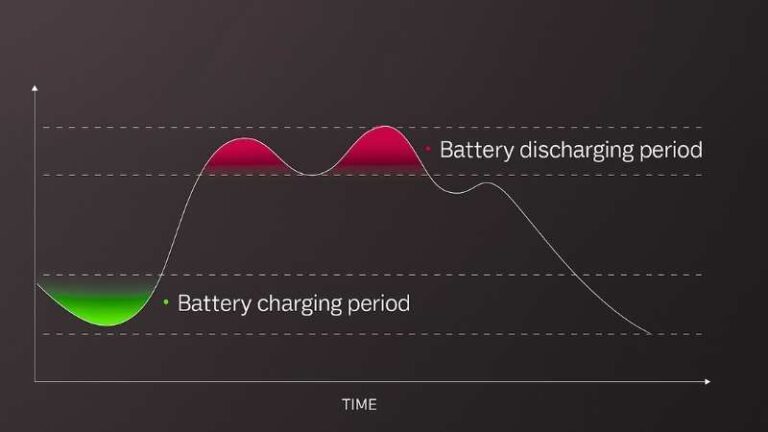
Industrial ESS reduces demand charges through a process known as peak shaving.
When facility load approaches a predefined threshold:
- The battery system automatically discharges
- Grid power demand is capped at a lower level
- The peak event is absorbed by the battery
Once demand subsides, the battery recharges during low-load or low-tariff periods.
This entire process is controlled by the Energy Management System (EMS) and happens without disrupting operations.
Key Components Enabling Demand Charge Reduction
An effective industrial ESS for demand charge management includes:
- Battery Energy Storage System (BESS)
- Battery Management System (BMS)
- Power Conversion System (PCS)
- Energy Management System (EMS)
- Real-time load monitoring and control
The EMS continuously analyzes facility load, predicts peaks, and dispatches battery power accordingly.
Benefits of Using Industrial ESS for Demand Charge Reduction
Immediate and Measurable Cost Savings
Demand charge reduction delivers direct financial benefits that are easy to quantify. Lower peak demand translates into reduced monthly electricity bills.
No Impact on Production or Operations
Industrial ESS operates transparently in the background, supplying power during peak events without affecting production schedules or equipment performance.
Improved Power Quality and Stability
By smoothing load fluctuations, battery systems also enhance voltage stability and reduce stress on electrical equipment.
Reduced Grid Dependency
Peak shaving lowers reliance on the grid during high-demand periods, improving energy resilience and flexibility.
Demand Charge Reduction in the Middle East Context
Industrial facilities in the Middle East face unique energy challenges:
- High power demand in energy-intensive industries
- Rising electricity tariffs and capacity-based charges
- Increasing use of electric-driven industrial equipment
- Grid constraints in rapidly developing industrial zones
In countries across the GCC, industrial ESS is increasingly used to manage demand charges, especially in manufacturing, ports, logistics hubs, and processing plants.
Combining Demand Charge Reduction with Other ESS Applications
Industrial ESS for demand charge management can be combined with:
- Backup power support
- Load shifting and tariff optimization
- Solar energy integration
- Microgrid operation
This multi-use approach improves overall system economics and shortens payback periods.
System Sizing and Design Considerations
Effective demand charge reduction requires careful system design, including:
- Accurate load profile analysis
- Identification of peak duration and frequency
- Battery power and energy sizing
- Control strategy definition
Oversizing or undersizing the ESS can reduce financial benefits, making proper engineering essential.
Return on Investment and Payback
Demand charge reduction is often the primary driver of ROI for industrial ESS projects. Facilities with frequent or high peak loads typically achieve:
- Shorter payback periods
- Predictable cost savings
- Improved energy cost forecasting
When combined with other applications, industrial battery energy storage becomes a strategic long-term asset.
Conclusion
Demand charge reduction using Industrial Battery Energy Storage Systems is one of the most effective and financially attractive applications of energy storage for factories and industrial facilities. By controlling peak power demand, industrial ESS delivers immediate cost savings, improved power quality, and enhanced energy resilience.
As electricity pricing structures evolve, demand charge management will remain a key justification for industrial energy storage investments.
If you are evaluating Industrial ESS or Industrial BESS solutions for demand charge reduction, or want to assess potential cost savings for your facility, you may contact us at [email protected] to discuss load analysis, system sizing, and implementation strategies.